

Generally speaking, in order to compliantly hire an employee in any given country, a company must be registered or incorporated in that country. The same is true of employers of record (EORs).
EORs operating globally are incorporated in all countries, right? Wrong. No EOR is incorporated in every country.
So how do they provide services globally? EORs operate in one of three models: Direct, Indirect, or Hybrid.
The three EOR operating models
An EOR providing services through a direct model has incorporated or registered their own entity in the country for which they provide services. For example, the EOR’s own French entity employs French nationals to provide services to its customers.
An EOR providing services through an indirect model is not incorporated or registered in the country in which they are providing services. Instead, they subcontract with a local partner to provide services. For example, the EOR contracts with a local partner in Guatemala, who employs local nationals to provide services to the EOR, who in turn provides services to its customers.
An EOR providing services through a hybrid model uses both direct and indirect models.
The advantages and disadvantages of all three EOR models
There are pros and cons with each model, as well as a lot of misinformation and stereotypes. Let’s dive a little deeper into the models.
The direct EOR model
A well-run EOR operating through a direct model has local expertise and experience, and should provide timely and cost efficient service. The advantage of a direct model is that there is no partner for the EOR (or customer) to manage. The EOR is free to make its own policies, practices, and contracts, without having to align or harmonize them with a local partner.
It sounds great, and it is great. The disadvantage is simply that the EOR’s services are limited to the countries in which they are incorporated, and no EOR is incorporated in every country. If you only need assistance in a handful of locations, you may be able to find an EOR operating directly that meets your needs.
The indirect EOR model
An EOR operating through an indirect model leverages its local partner’s in-country knowledge, nuanced experience, and local adjacent business service contacts (like accountants, lawyers, co-working spaces, and the like). Another benefit of the indirect model’s use of local partners, is that the EOR isn’t limited to providing services in countries where the EOR, itself, is incorporated. Local partners networks allow an EOR to cover more countries, which is key for customers who want a one-stop shop and are expanding into multiple countries or regions.
EORs operating under the indirect model should provide seamless service and the local partner should be invisible; you shouldn’t feel like you are being passed along to another company at all. An example is when you book a flight from any major airline, but as you board the plane, you notice that it is “operated by” a regional airline affiliate. The flight path is the same, the plane is the same, the ticket is the same, the mobile app is the same, but the whole experience is powered by a local partner. It is a seamless, indirect model. Unfortunately, not all EORs integrate their local partners into their operations and being handed off to local partners can be a surprise, add to your administrative work, and ultimately lead to a stressful and disjointed experience. If you are exploring EORs operating under the indirect model, make sure to explore how they interact with their local partners.
The hybrid model
The hybrid model is a combination of both models. An EOR operating in a hybrid model incorporates entities in some countries, while leveraging local partners in others.
Dispelling myths about the indirect EOR model
Myth #1: Indirect doesn’t protect intellectual property as well.
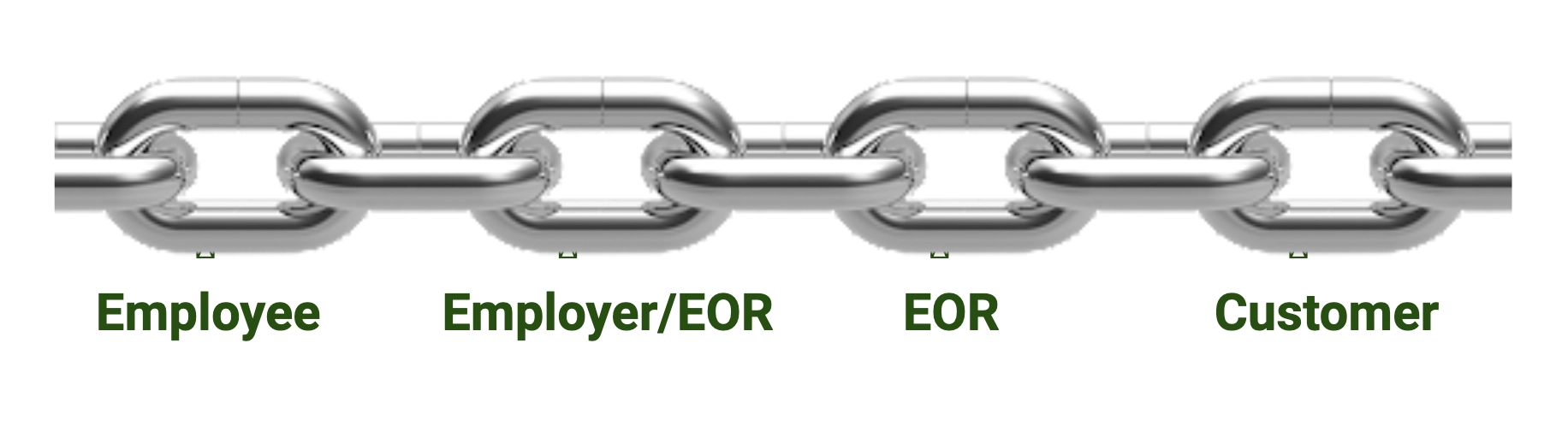
EORs operating under both direct and indirect models protect and transfer employee IP to customers contractually. Think of it like a chain linking the employee to the formal employer to the company benefiting from the work. A chain with four links is as strong as a chain with three links. The important part of IP transfer is how strong the links are, not how many.
Myth #2: Indirect costs more.
While an EOR operating an indirect model will pass along its local partner costs to its customers, those costs could be equivalent to the actual administrative costs of the EOR operating a direct model. Nothing about the models, themselves, dictates that the indirect model costs more or that a direct model EOR won’t charge extra for some services or change their fees. Make sure to review any contract carefully and ask questions. Transparency and trust is important in any EOR relationship.
Myth #3: Without direct control, you can’t be compliant.
Control does not equal compliance. Anyone with a puppy or small child can tell you that. What does make a difference when complying with ever changing laws and regulations is good processes, automated systems, and regular audits. Luckily, those are not reserved just for EORs operating under a direct model.
Myth #4: EORs using local partners don’t understand local laws.
Employment law is localized. Some providers argue that local partners have a better pulse on the practices within a country, and a lot more experience than a newly incorporated EOR. The truth is, whether your EOR is incorporated in a country or works with a local partner in that country, you will benefit from the knowledge and expertise of local employment professionals, who understand the laws and customary practices of their country.
Making the right choice for your business
Finding the EOR that meets your company’s needs and service standards is a strategic decision, and there is not a one-size-fits-all solution. Consider where you are looking to expand your operations and what kinds of support you need from your EOR. When looking at your EOR options, ask which model they use and how they operate their model. Finally, keep in mind that regardless of the model chosen, some EORs may execute better on a particular model or in a particular region than others. Operating directly in a country provides the opportunity for efficiency, localized knowledge, and quick response time, but it doesn’t guarantee that. Operating indirectly could be a clunky handoff or alternatively, it could be a seamless, integrated experience providing worldwide service.
At Oyster, we operate under the hybrid model and believe it is the best of both worlds. We use local partners to test new markets and learn about local customs and nuances in the law, which paves the way for incorporating entities in countries where we can create value for our customers through a direct model. Through this hybrid approach, we can handle your expansion anywhere in the world: all of your service providers under one umbrella, with one platform, unified contracts and benefits, and a single contract point.
Disclaimer: This blog and all information in it is provided for general informational purposes only. It does not, and is not intended to, constitute legal or tax advice. You should consult with a qualified legal or tax professional for advice regarding any legal or tax matter and prior to acting (or refraining from acting) on the basis of any information provided on this website.
Is your business hiring remote contractors? Make sure you take these potential issues into consideration.
About Oyster
Oyster is a global employment platform designed to enable visionary HR leaders to find, hire, pay, manage, develop and take care of a thriving global workforce. It lets growing companies give valued international team members the experience they deserve, without the usual headaches and expense.
Oyster enables hiring anywhere in the world with reliable, compliant payroll, and great local benefits and perks.





.avif)