


Making money in your sleep is every digital nomad's dream. Imagine waking up every morning in your Bali beach hut to payment notifications from passive income streams that allow you to work as much—or as little—as you like.
There are many ways to make passive income, and while they're not usually as "passive" as people make them out to be (they often require a decent amount of work to set up), one of the easiest ways to create a new income stream is through affiliate marketing.
3.78% of affiliate marketers receive payouts of over $150,000 per year, while the majority—57.55%—make under $10,000, according to a report on the State of Affiliate Marketing. Where you fall on that scale depends on how large an audience you manage to build, but at the very least, you'll be able to make some money toward your next plane ticket.
Many companies use affiliate marketing to outsource their marketing campaigns to third parties like digital nomads in exchange for small commissions on each purchase. If you've ever seen a blog or YouTube video promoting a product or website, chances are the creator is an affiliate marketer for that company.
This article will cover the types of affiliate marketing available to digital nomads, the core skills every successful affiliate marketer possesses, and some tips on setting yourself up as an affiliate marketer.

What Is Affiliate Marketing?
Affiliate marketing is a performance-based marketing model where you earn commissions by promoting other companies' products or services. You receive a unique tracking link, share it with your audience, and earn money when someone makes a purchase through your link.
Think of it as being a digital matchmaker. You connect businesses with customers who need their products, and you get paid for making that connection. No inventory, no customer service headaches—just you, your content, and the relationships you build with your audience.
Sound familiar? If you've clicked on a product recommendation in a blog post or YouTube video description, you've experienced affiliate marketing from the customer side. Now it's time to flip the script and become the one earning those commissions.
Why Affiliate Marketing Works for Digital Nomads
Let's be honest: the nomadic lifestyle comes with unique financial challenges. Traditional remote work isn't always flexible enough for constant travel, and client work can tie you to specific time zones. That's where affiliate marketing becomes a game-changer.
So why does affiliate marketing work so well for digital nomads? Simple—it adapts to your lifestyle instead of controlling it.
Here's why it's particularly suited to the nomadic lifestyle:
The Models Available in Affiliate Marketing
An affiliate marketer can be an individual person or an entire company. All that matters is that they have a platform that companies can leverage for their marketing efforts. A platform could be a blog, website, podcast, YouTube channel, a regular newsletter to your email list, or even your social media posts.
It's up to you which medium you choose—the important thing is to establish yourself on a platform where you regularly publish content, build an audience, and raise brand awareness about your chosen product.
The most basic form of affiliate marketing is when the affiliate marketer embeds a link in their content to drive traffic to another company's website, leading to affiliate sales.
When someone makes a purchase through their referral link, the affiliate marketer receives a commission. This is why it's important to start by creating content and building an audience—the larger your audience, the more affiliate commissions you're likely to earn.
Other affiliate marketing models include:
Some companies even pay a regular commission long after you help make the initial sale through a system called "rebilling". Landing a rebill-based product can be challenging, but it's worth putting in the work to earn a regular, passive paycheck.
What Is a Digital Nomad?
Digital nomads aren't tied to a single location—most only need their laptop and an internet connection to work from anywhere in the world.
Some move from one country to another, establishing the new location as their home base for a few months, while others have one home base but travel regularly, taking their work with them.
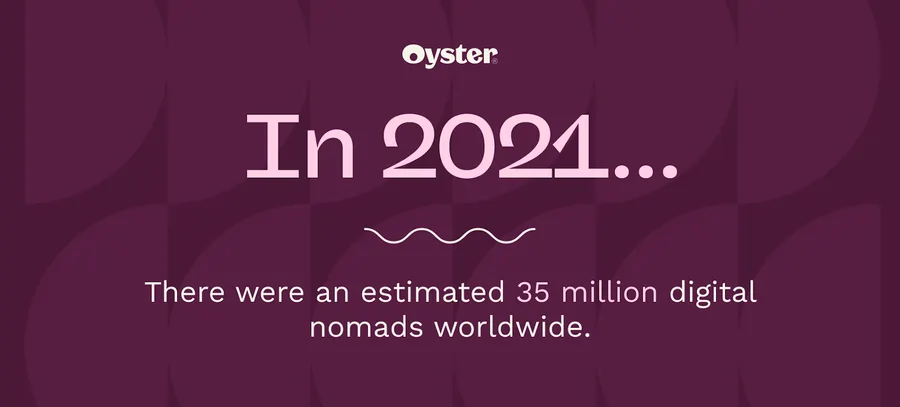
The number of digital nomads has been growing for years, a trend that has accelerated in the wake of the pandemic. In key industries like information services and software publishing, the majority of workers (over 50%) worked from home in 2021, a steep increase from just 15-20% in 2019.
While many of these workers are self-employed, a growing number are remote employees of businesses that allow them to work from anywhere in the world. Research from the U.S. Bureau of Labor Statistics shows that from 2019 to 2021, the average percentage-point increase in remote workers across industries was 14.9.
It's easy to see why this kind of lifestyle is attractive—it offers flexibility, independence, and the opportunity to travel the world while you work. However, earning a steady income can be a challenge for digital nomads, so adding an extra income stream like affiliate marketing is a wise move.
💡 Pssst... Are you a digital nomad looking for a new gig? Check out Oyster's Global Employment Pass for a set of resources that will help you land the job of your dreams.
How Much Can You Earn With Affiliate Marketing?
Here's what nobody tells you about affiliate marketing income: it's not a get-rich-quick scheme, but it's also not pocket change if you do it right. The numbers vary wildly, and that's actually good news—it means there's room for growth.
Here's what realistic earning progression looks like:
What separates successful affiliate marketers from those earning pocket change?
The beauty of affiliate marketing is that it scales with your effort. Unlike traditional employment where your income is capped by hours worked, your content can earn money long after you've published it. That blog post you wrote six months ago? It could still be generating commissions while you sleep.
Skills of a Successful Affiliate Marketer
Many digital nomads already possess the necessary skills to make a decent affiliate income. It's common for them to have large social media followings, and influencers are a natural choice for companies to form partnerships with.
Don't have a huge following yet? No problem. You probably already have valuable skills like SEO or digital marketing that companies want.
Here are three core skills that set successful affiliates apart:
1. Staying organized
Whether it's delivering work on time, requesting tourist visas, or organizing calls with people in different time zones, digital nomads have the ability to juggle and prioritize a variety of tasks thanks to their strong organizational skills.
The ability to stay organized is crucial for succeeding with affiliate marketing, making it a natural fit for many digital nomads.
2. Conducting research
As an affiliate marketer, you may have to carry out different types of research, ranging from competitor analyses to keyword group identification.
Digital nomads tend to be skilled at conducting research due to the nature of their work and lifestyle. They're used to self-directed learning and can easily pick up anything they're unsure of using tutorial videos.
3. Interpreting data
Conducting research is one thing, but figuring out how to analyze and interpret data metrics can be more challenging.
Digital nomads are often skilled at collecting information and evaluating their options to make the best possible decision.
This applies to both their professional and personal lives, since you may find a digital nomad creating a content plan one minute and a travel itinerary the next.
How a Digital Nomad Can Become an Affiliate Marketer
Ready to turn your travels into income? Here's your step-by-step roadmap to get started.
1. Choose your niche
The first thing to remember is that your job is to connect a retailer with their target audience, so you need to make sure you align yourself with the products in your niche. For example, you wouldn't do product reviews of baby products on a blog about living a child-free lifestyle.
Choose a niche you're passionate about, such as lifestyle, dating, food, parenting, or health, so you can position yourself as a go-to affiliate marketer for products in that niche. Although it's important to align with your passions, you must also make sure there's demand for content and new products within the niche you've chosen.

You may also want to consider partnering with a CPA network. These are third-party websites that connect businesses with publishers (aka affiliates). Some popular affiliate networks include:
2. Select products that fit your niche
The key to success as an affiliate marketer is to build trust with your audience. Be selective and make sure you're recommending a company's products that you actually use and genuinely believe will improve your audience's lives in some way.
3. Conduct market research and analyze your competitors
Although you can technically pick any niche in the world, not all of them are profitable. So it makes sense to choose one where there's demand for both content and products or services.
An important part of this process is to analyze your competitors. If other people are already making money in your chosen niche, it's a good sign as it means there's money to be made there.
It also means you can steal their secrets by analyzing their strategies and replicating them as you find your voice and grow your unique audience.
4. Create quality content
Last, but certainly not least, is content marketing. Successful affiliate marketers are content creators who build audiences through a solid affiliate marketing strategy.
To do that, you need to focus on creating high-quality content that resonates with your target audience, provides value, inspires, and entertains in equal measure.

Begin with solving your audience's problems and work backward from there. Don't start by focusing on pushing an affiliate product, as that will come off as insincere and simply won't work.
Aim to create content that's a natural fit for the products you want to promote. For example, if you partner with a garden tools brand, build your online marketing around tips and hacks for gardeners. This way, inserting a link to your chosen brand will seem genuine rather than forced.
Building Your Affiliate Marketing Income as a Digital Nomad
Affiliate marketing is a great way for digital nomads to make a little extra income, whether they're self-employed entrepreneurs or working remotely for a small business. It's a natural fit for digital nomads, who already have most of the skills necessary to succeed in online business.
Digital nomads will continue to be at the forefront of the remote work revolution, and companies that offer remote work opportunities will find it easier to attract and keep top global talent, especially since data shows a rise in remote work is associated with an increase in TFP growth, or total factor productivity.
As you build your affiliate marketing business, remember that sustainable income comes from providing genuine value to your audience. Focus on building trust, creating quality content, and choosing products that truly benefit your followers. The passive income will follow.
Whether you're looking to supplement your nomadic income or build a location-independent business, affiliate marketing offers a path that works with your lifestyle, not against it. Start exploring how Oyster can help you manage your global work life while you build your affiliate empire.