
Can an independent contractor have a company email address?

Company email addresses for independent contractors.

Tablet with an email notification

Oyster Team

Just the same as a full-time or part-time employee, a company can legally assign a company email address to an independent contractor—a role that represents the most common alternative employment arrangement.

If you assign an independent contractor an email address, it's natural to have concerns about misclassification. On a standalone basis, there's nothing to worry about if you decide to go down this path.

However, it's responsible to think about misclassification and the potential impact on your business. Misclassifying an employee as a contractor could result in both IRS penalties and legal authority penalties, as the IRS states you may be held liable for employment taxes for that worker if there is no reasonable basis for the classification.

Worried you've misclassified a contractor? Get answers using Oyster's Contractor vs. Full-Time Analyzer.

Understanding Contractor Misclassification

Here's the bottom line: giving a contractor a company email address won't automatically trigger misclassification. However, tax authorities like the IRS evaluate your entire working relationship. For complex cases, the agency may even review the facts and circumstances via a Form SS-8 filing to make an official determination, focusing on three key areas:

  • Behavioral Control: Do you control how, when, and where the worker does their job? Providing extensive training or requiring work to be done at a specific time and place points toward an employment relationship.
  • Financial Control: Do you control the business aspects of the worker's job? This includes how the worker is paid, whether expenses are reimbursed, and who provides the tools and supplies. Contractors typically use their own equipment and are paid per project.
  • Relationship of the Parties: How do you and the worker perceive your relationship? Is there a written contract describing the relationship? Does the business provide the worker with employee-type benefits, such as insurance or paid time off?

So where does email fit in? It's a minor factor on its own, but combined with other control elements, it could tip the scales toward misclassification.

Key takeaway: Focus on the big picture of your contractor relationship, not just the email address.

What About Independent Contractors in Foreign Countries?

The rules get trickier when you're working across borders. Each country has its own contractor classification requirements, so you'll need to review local regulations.

Quick assessment:

If you've assigned a company email address to an independent contractor or plan to do so in the future, take all the guesswork and risk out of the process by implementing Oyster's suite of contractor management tools.

And if you ever find yourself in a situation where you want to work with this contractor for the long haul, we can also help you compliantly transition them to full-time employment. (We call ourselves an all-in-one global employment platform for a reason!)

Best Practices for Contractor Email Management

Want to give contractors company email access? Smart move—just set clear boundaries first. Here's how to do it right:

  • Create a clear policy: Document why the contractor needs an email address—such as for client communication or access to specific project management tools—and have them sign it.
  • Use a distinct email format: Differentiate contractor emails from employee emails. For example, use a format like 'firstname.lastname.contractor@company.com'.
  • Limit internal access: Restrict access to internal-only systems, distribution lists, and company-wide calendars that are not essential for their project.
  • Define email signature guidelines: Require contractors to identify themselves as an 'Independent Contractor' in their email signature to avoid confusion with clients and internal teams.

Protecting Your Business from Misclassification Risk

Email policies are just the start. The real protection comes from managing your contractor relationships properly.

Essential safeguards:

  • Compliant contracts: Use locally appropriate agreements
  • Proper payment: Handle invoices and taxes correctly, as the IRS requires you to file all required federal information returns consistent with your treatment of the worker to qualify for certain relief provisions.
  • Regular assessment: Review the working relationship periodically

Managing all this complexity manually? There's a better way. Platforms like Oyster handle locally compliant contracts and streamlined contractor payments across 180+ countries, taking the guesswork out of global compliance.

Managing Global Contractors with Confidence

Giving a contractor a company email address is permissible, but it requires a thoughtful approach. The key is to ensure this small convenience doesn't blur the lines of the overall work relationship. By establishing clear policies and managing your contractors through a compliant framework, you can provide them with the tools they need to succeed while protecting your business.

Whether you're engaging contractors, employing full-time team members, or converting contractors to employees, Oyster provides the tools and expertise to help you build your global team the right way. Ready to hire talent anywhere without the headache? Start hiring globally with confidence.
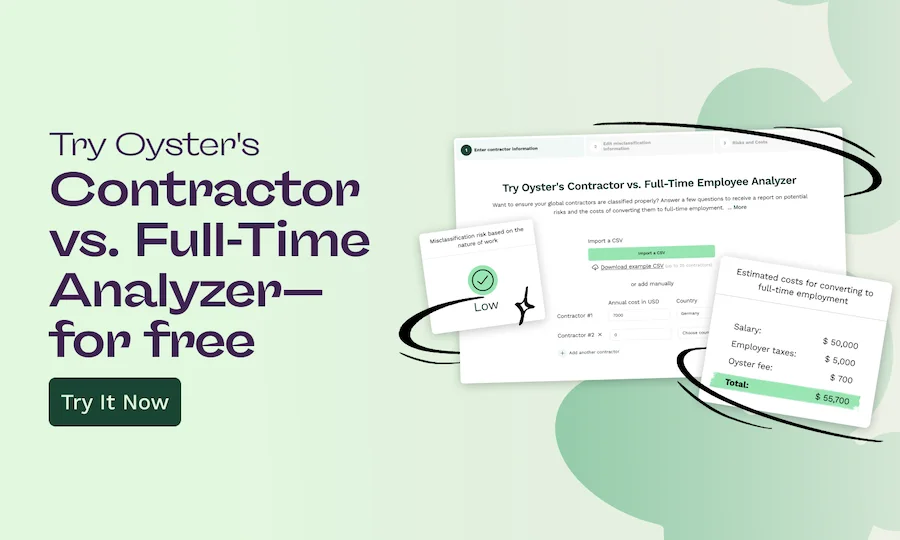
Try Oyster's Contractor vs. Full-Time Analyzer for freeAbout Oyster

Oyster is a global employment platform designed to enable visionary HR leaders to find, engage, pay, manage, develop, and take care of a thriving distributed workforce. Oyster lets growing companies give valued international team members the experience they deserve, without the usual headaches and expense.

Oyster enables hiring anywhere in the world with reliable, compliant payroll, and great local benefits and perks. Make this part of your standard contractor onboarding.

Learn more about Oyster

Watch our explainer video to learn all you need to know or book a demo with our team to get direct information.

Illustrated world map with simplified continents on a folded paper against a dark, radial background.

About Oyster

Whether you’re engaging employees, contractors, or running payroll across borders, Oyster helps you bring on great talent by making global employment simple and human.

With Oyster, you get a platform that moves fast and in-house HR experts who care about getting it right. As the only B Corp-certified EOR, you can be sure that when you grow with Oyster, you grow responsibly.

Book a demo to access our best pricing for readers

FAQs

What is an “Oyster HR independent contractor” email, and is it legit?

I received an onboarding email—what should I verify before I share my ID, address, or bank details?

If my company gives me a contractor email, who owns it, and what happens when the contract ends?

What email format should I use for independent contractors so clients don’t get confused?

If you do issue an independent contractor email, choose a format that signals the relationship without making the contractor look like a standard employee. A practical approach is to use a consistent naming convention that includes a contractor indicator, then reinforce it in the display name and signature so external recipients understand the role. This is less about aesthetics and more about reducing brand risk, avoiding client confusion, and keeping your internal teams aligned on who can make commitments on behalf of the company.

How can I sanity-check contractor classification risk beyond “they have a company email”?

Email is rarely the deciding factor—classification risk shows up in the day-to-day operating model. If you’re setting fixed working hours, assigning a manager to direct how the work is done, folding the contractor into employee-only programs, or making them dependent on your tools and processes to deliver, you’re moving closer to an employment relationship even if the contract says “independent contractor.” If you want a structured way to pressure-test the relationship, use a guided assessment like Oyster’s Contractor vs Full-Time Employee Analyzer to identify where the risk is coming from and what to change before it becomes a compliance problem.

Book a demo to access our best pricing for readers