.webp)


You've decided to employ someone in a new country. Maybe it's a brilliant engineer in Brazil, a salesperson in Germany, or a contractor you finally want to convert to a full-time employee. You don't want to set up a local entity for one or two people, so you start looking at Employer of Record (EOR) providers.
Then the comparison spreadsheet gets complicated. Every vendor says they're compliant. Every vendor says they're easy to use. Every vendor says they have expert support. So how do you actually tell them apart before you sign?
Choosing the wrong EOR doesn't announce itself on day one, but shows up later as a surprise offboarding fee, a payroll error nobody owns, or a compliance gap you discover during due diligence.
This guide gives you a practical framework to evaluate providers with confidence, so you choose a partner for the long haul.
Want the full scoop? Access the complete EOR Buyer's Guide now.
What an EOR is, and when you actually need one
An Employer of Record (EOR) is a company that legally employs talent on your behalf in countries where you don't have a local entity. The EOR handles the compliance, payroll, benefits, and paperwork. You manage the day-to-day work and the relationship. It's how you build a global team without building global infrastructure.
An EOR is usually the right move when you want to:
- Employ someone in a new country quickly, without setting up an entity
- Expand into a new region and need local expertise on the ground
- Test a market before committing to permanent infrastructure
- Convert contractors to employees for compliance, retention, or benefits
A good EOR does more than process payroll. It should enable compliant growth, letting you move fast in new markets while someone with real local knowledge keeps you on the right side of the law.
How to evaluate an EOR: 5 criteria that matter
Most EOR providers look similar on a feature list. The differences surface in five areas. For each one below, you'll find what to look for, questions to ask, and a quick tip to cut through the sales pitch.
1. Country coverage and infrastructure
The list of countries an EOR supports matters because your hiring plans change. The country you don't need today may be the one you need next quarter. But coverage alone is a vanity metric. What matters is depth of expertise in the countries you actually care about.
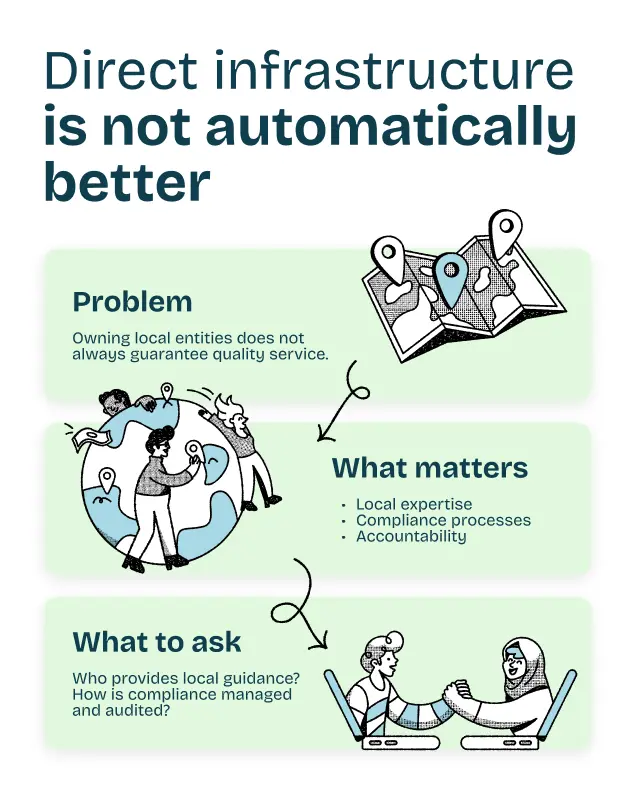
There are two models, and neither is automatically better:
- Direct (owned entities): The provider owns the legal entity in a country.
- Indirect (vetted partners): The provider works with carefully selected local partners.
You'll hear that "direct-only is better." It's a myth.
Owning an entity in a country can speed up onboarding, minimize support handoffs, and create a more consistent employee experience, yet it doesn't guarantee that anyone there can advise you on parental leave, severance, or local benefits norms. Meanwhile, a strong partner model, built on carefully vetted local experts, can speed up your expansion and bring deeper in-country knowledge than a thinly staffed owned entity.
Questions to ask:
- How many countries do you cover, and which are owned entities versus partners?
- If you use partners, how do you vet them and maintain accountability?
- Who provides local expertise in the specific countries I'm hiring in (whether direct or indirect), and what are their qualifications?
Tip: Look for depth, not just breadth. Ask a hard, country-specific question during the sales process and see whether you get a real answer or a shrug.
2. Compliance and risk
An EOR's primary job is to protect you from risk. On a global scale, that's harder than it sounds: every country has its own employment laws, tax rules, and termination requirements, and they change constantly. A single misstep can mean fines, lawsuits, or a failed due diligence process.
Be wary of any vendor that says "yes" to everything. A provider that approves every type of hire without asking questions isn't reducing your risk, it's increasing it. Real compliance shows up in three places: it's built into the tech workflows, it's backed by genuine in-house expertise, and it's safeguarded by clear liability protection.
Questions to ask:
- What does your compliance process cover, from contract review to benefits to tax reporting?
- How do you handle liability if something goes wrong?
- Will you tell me when a hire is risky or noncompliant, even if it costs you the deal?
Tip: Do a quick search for lawsuits or compliance concerns before you sign, especially if you're in a regulated industry or raising funding. A social impact commitment like B Corp certification can signal a culture of doing the right thing.
3. Platform and ease of use
The platform is where your team lives day to day. A good one reduces HR admin work, cuts down manual and error-prone processes, and makes the experience better for your team members. A clunky one creates work where there should be none.
Look for a platform that handles the essential workflows well:
- Compliant contract generation
- Efficient team member onboarding
- Payroll cycle management
- Benefits administration
- Lifecycle management: time tracking, salary and job changes, offboarding
- Reporting and analytics
Self-serve knowledge matters too. Hiring guides, country comparisons, and employment tools let your team answer basic questions without waiting on a ticket. And integrations with your existing Human Resource Information System (HRIS), payroll, or finance systems prevent duplicate data entry, which is where errors creep in.
Questions to ask:
- Can managers and team members self-serve answers to common questions?
- Does the platform integrate with my existing HRIS, payroll, and finance tools?
- Which workflows are automated, and which still require manual work?
Tip: Watch out for all-in-one pitches that bundle modules you don't need. If you already have expense management, make sure you won't be forced onto theirs.
4. Support model
Technology gets you scale. It doesn't get you through a sensitive termination in Europe or a layoff round. Global employment is full of moments that software alone can't solve, and that's when the quality of human support decides everything.
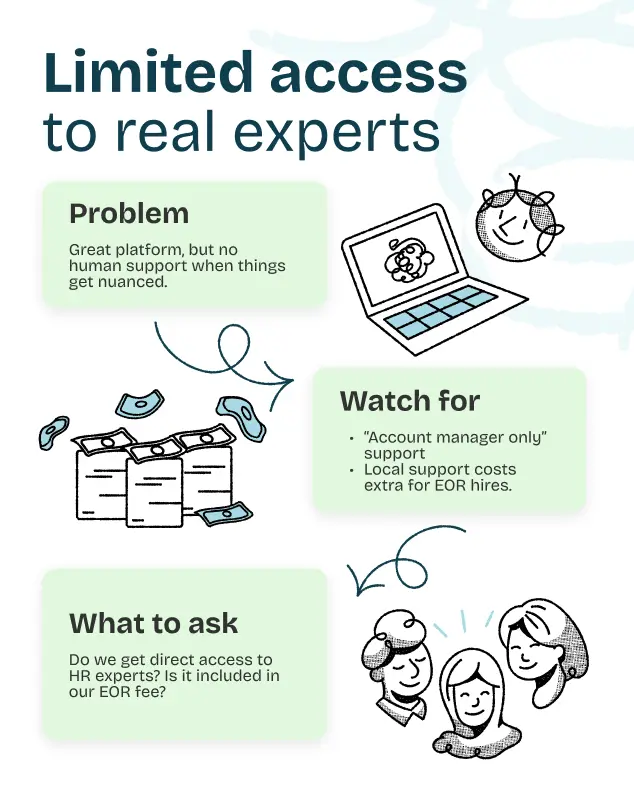
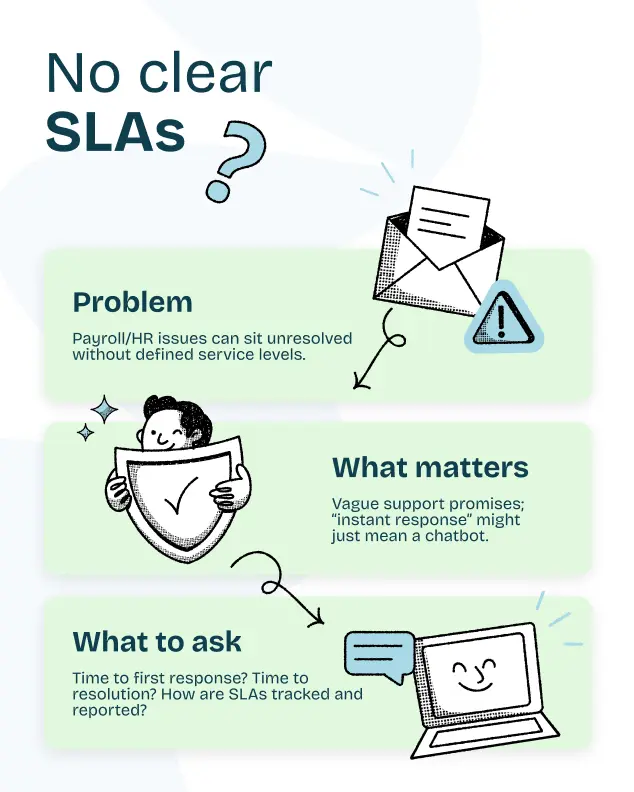
You want access to real experts in legal, HR, and payroll, not just a chatbot or a generalist reading from a script. The right partner provides guidance, care, and empathy when situations get complex. And good support is measurable: ask how they define and track their service level agreements (SLAs), and whether those metrics reflect real resolution or just look good on a slide.
Questions to ask:
- Will I be supported by specialized experts, or only generalist agents?
- What are your SLAs for first response and resolution, and how do you track them?
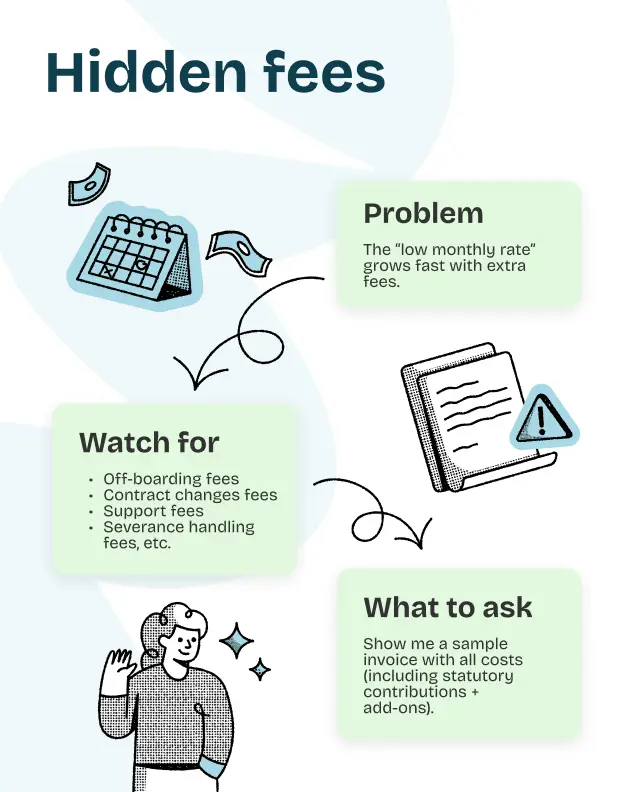
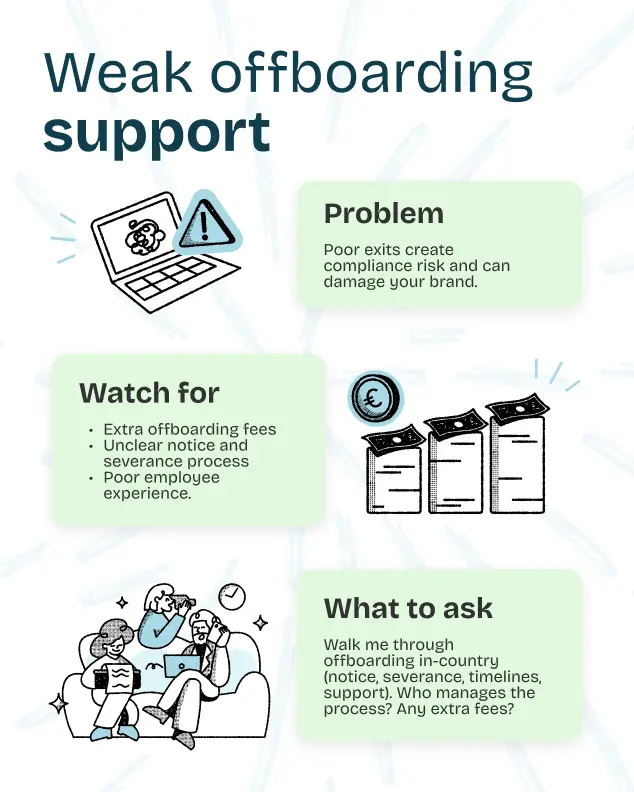
- How do you support high-stakes moments like terminations or layoffs, and does it cost extra?
Tip: Find out when you get access to experts. Many providers charge for expert access as an add-on during exactly the moments you need it most, like offboarding.
5. Team member experience
Here's what's easy to forget: the EOR becomes the legal employer of your people. It touches their payroll, benefits, time off, and onboarding. Their experience with the EOR directly shapes their satisfaction, engagement, and whether they stay.
Payroll accuracy comes first. Getting payroll right, on time and in local currency, is the fastest way to build or break employee trust. Onboarding matters just as much, because the EOR model is unfamiliar to many team members. Clear, localized guidance helps them feel secure at the start of a new job. And an intuitive team member interface, where they can find payslips, check benefits, and request time off, makes the whole relationship feel solid.
Questions to ask:
- How do you ensure payroll is accurate, on time, and in local currency?
- What does onboarding look like from the team member’s point of view?
- What self-serve tools do team members get for payslips, benefits, and time off?
Tip: Ask how the provider communicates with your team members during sensitive moments like parental leave or termination. That's where experience is made or broken.
Common pitfalls to watch for
A quick orientation before the visuals: most EOR regrets trace back to a handful of avoidable traps. Knowing them in advance is half the battle.
Why teams choose Oyster
The five criteria above are how we think you should evaluate any provider, including us.
Here's where Oyster stands:
- Human, expert-led support for the moments that matter. You get more than a platform. Every customer has a dedicated point of contact backed by a global team of specialists who guide you through everything from your first hire to a complex termination. Real answers, not scripts.
- Transparent pricing, no surprises. What you see is what you pay. Essentials like HR guidance and offboarding support are included in your subscription, so you're never billed extra at the worst possible moment. Finance teams get consolidated invoices with detailed breakdowns.
- Built on integrity, certified for impact. Oyster is the only EOR certified as a B Corporation, independently vetted for how we treat people and run our business. If something is risky or noncompliant, we'll tell you and help you find a better path.
Aušrinė Keršanskaitė, Co-founder of Operations Nation, explains how Oyster helped Operations Nation hire their first international employee: “With our previous EOR, there was a lot of second guessing and it created quite a bit of stress both for me and for the employee. With Oyster, that stress just isn’t there… I spend zero time firefighting or chasing issues.” Read more about how Oyster removed the compliance burden and gave a small team the confidence to hire globally
Get the full EOR Buyer Guide
This post covers the evaluation framework. The full guide goes further, with the parts most useful when you're sitting across the table from a vendor:
- 8 critical questions to ask any EOR provider: plus what a strong answer actually sounds like
- The complete EOR evaluation checklist: a printable scorecard to compare providers side by side
If you're actively comparing vendors, these are the tools that help you avoid mistakes and cost surprises before you sign.





.webp)