

Every HR leader running (or starting) a global team has a version of this story: a decision that made sense on a Tuesday call and turned into an outside counsel invoice three weeks later. This is about the gap in between.
You don't need a global HR team of your own to have lived this. If you're the founder who made that Tuesday call yourself, it's the same gap, just with fewer people standing between you and the invoice.
"Living 10,000 lives in one life."
That's how Pawel Kononczuk describes what it's like to manage people operations across dozens of countries, for thousands of clients, over more than a decade in global HR.
And no, he's not exaggerating for effect. He means that at the volume his team operates, you stop being surprised by anything… and that changes what you think the job actually is.
Pawel is Senior Manager of People Services at Oyster HR, an Employer of Record. If that term is new to you, here's the short version: companies use Oyster to employ people in countries where they don't have a legal entity. Oyster becomes the legal employer of those team members, and the company directs their day-to-day work.
People Services is the team those companies call when the work gets complicated. It's Oyster's customer-facing group of senior HR Business Partners, and they advise customers on terminations, restructures, grievances, local employment practices, and every other people matter involving the team members a customer employs through Oyster. (If you assumed People Services handles HR for Oyster's own staff, you're in good company. They don't. Different job entirely. 😉)
Pawel leads seven of the team's eleven senior HRBPs, who average nearly 15 years of international experience each. Before managing the team, he did the job himself.
His argument: the global people team's real job is translation. It’s holding three competing interests in tension in every case, and finding the outcome that serves all three. That's true whether the people team in question is Oyster's or the one down the hall from you. A team that only enforces rules can only ever manage the fallout.
What follows is the model Pawel has built from working thousands of those cases. The thinking that separates a people team that enables the business from one that cleans up after it. It starts with three chairs.
Key Takeaways:
Global HR teams should evaluate every cross-border people decision from three distinct positions:
- Compliance
- Business
- Team Member
Skipping any one of these produces either a legal problem, a commercial one, or a dispute. It's also how Oyster's People Services team works every customer case.
The call to HR should’ve come sooner
The most recurring cross-border HR problem isn't a hard one, but it is pretty common.
According to Atlas HXM's 2025 Global Atlas Report, 86% of HR leaders who manage international workforces say compliance with foreign labor laws is their biggest challenge. That number is mostly a measurement of companies who did the right thing too late.
Pawel sees a pattern that comes up in a handful of cases: a customer makes a people decision, sometimes a reasonable one, without looping in the people who know how that decision works in a specific country. By the time Oyster's People Services team gets the call, the decision has already been communicated.
"In some unique cases, we might even get contacted by clients who say, 'By the way, I spoke with that team member, I let them go,'" Pawel says. "And we need to work backwards from the situation."
Working backwards is always more expensive than getting ahead of it. The cases that generate the most cost are not always the complicated ones. They're the ones where someone assumed the local process would look familiar, and found out otherwise after the fact.
Treated that way, Oyster's People Services team becomes a cleanup crew instead of a partner. (The same goes for your own people team, if you have one.)
How good global HR decisions start with musical chairs
Pawel's central model for how his team advises Oyster customers comes down to one observation: every case involves three parties whose interests don't automatically align.
- Compliance.
- Business.
- Team Member.
When all three are held in tension at the same time, you get good outcomes. When one takes over the room, the other two become the next case.
If you've ever played musical chairs at a company offsite, you know the objective: move fast, grab a seat before anyone else, and hope you're not left standing when the music stops.
It's a fine party game, sure, but as a way of running cross-border people decisions, it describes exactly what goes wrong. The chair you don't sit in is always the one that generates the claim.
Before any significant cross-border people decision, a termination, a performance action, a restructure, a disciplinary, take it through and really think as if you’re sitting in three distinct chairs.
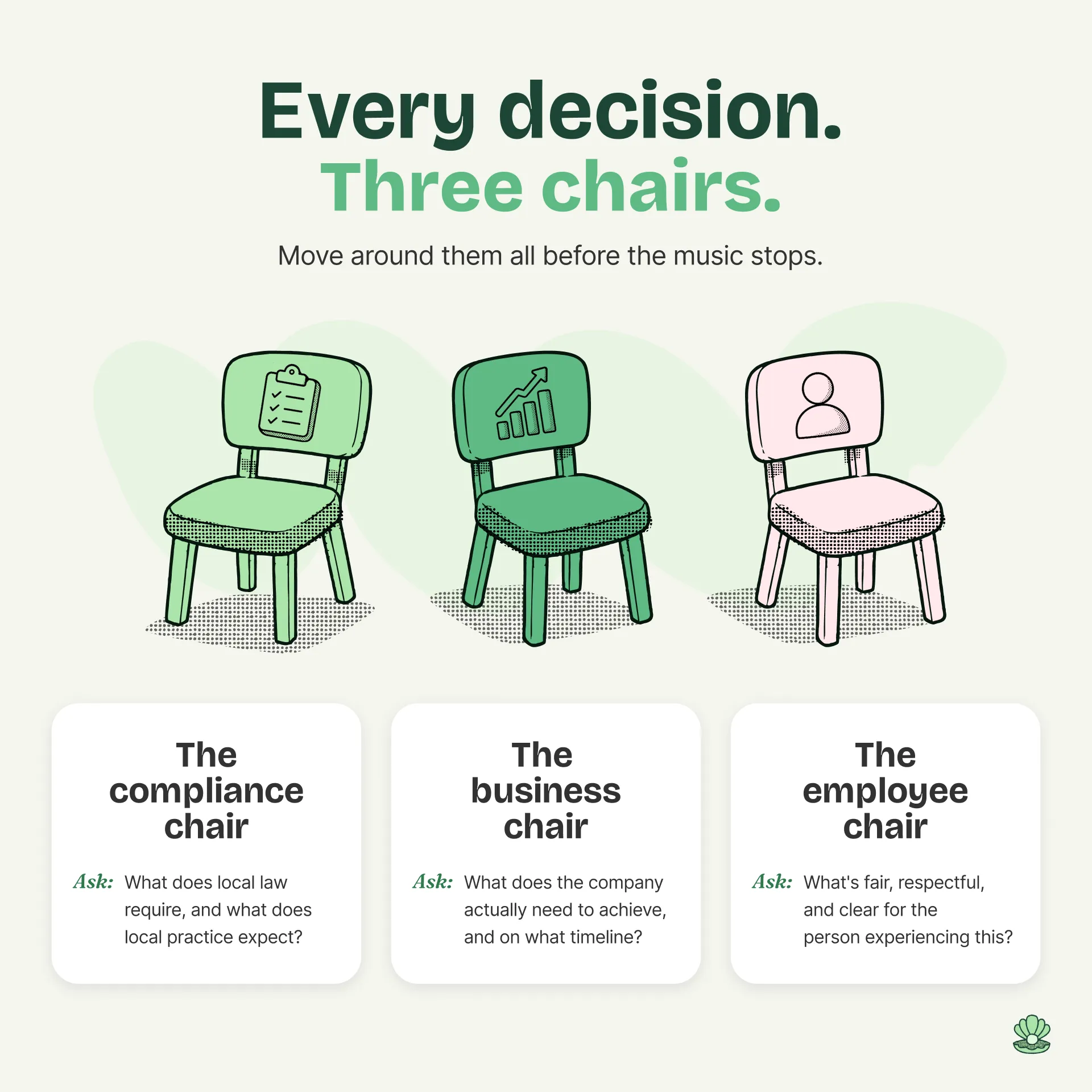
1. The compliance chair
Sit here and ask:
What does local law require, and what does local practice expect?
We’re not talking about what seems reasonable or what worked in a different country, but rather what is specifically required here, and what happens if it isn't followed?
In the Netherlands, termination requires either a mutual agreement or formal approval from a court or the Employment Agency. For Germany, informal conversations about performance can carry legal weight before any formal process has begun. But then in the United States, final pay rules vary state by state. (Some require payment on the team member’s last day, others allow until the next scheduled payroll run. Get the exit date wrong relative to those rules and payroll becomes the compliance problem.)
"Even the ‘easier’ countries," Pawel says, "can lead to complicated legal disputes if something is not followed."
The compliance chair is not optional, and neither is it sufficient on its own.
2. The business chair
Move here and ask:
What does the company actually need to achieve, and on what timeline?
This chair is where you ask the harder question: Is the plan I walked in with the right plan for this specific situation, or is it the plan that worked somewhere else?
A restructure budget that doesn't account for statutory severance in Spain and Argentina is more of a rough draft than a budget. An unlimited PTO policy applied globally without checking which countries have mandatory minimums will either duplicate existing entitlements or create an unenforceable benefit, depending on where you look.
"We need to understand how our interactions with the client affect the revenue, and affect their future commitments," Pawel adds.
The people team is not separate from the business since it either supports the business reaching a good outcome, or it slows everything down by being used as a final formality.
3. The team member’s chair
Move here and ask:
What is the experience of the person this decision directly affects?
Don’t brush this off as a soft consideration. It should be seen as more practical, Pawel says.
"It is our job to make sure that the team member, the client’s employee, has the best experience possible.”
A team member who is treated with clear communication and a fair process through a hard outcome is materially less likely to generate a dispute than one who is ambushed by it.
This chair also asks: if you were this person, would the process you're about to describe feel fair, even if the outcome is hard?
Most cross-border people mistakes come from spending the entire decision in one chair.
Compliance without commercial context produces processes that are technically correct and operationally ruinous. Commercial without compliance is how companies end up with a Zoom call and a problem in the Netherlands. Either without the team member in the picture is how disputes begin.
The point, as Pawel puts it: "There is an art in getting the right balance of challenging, making sure that you guide and consult, but at the same time not become the blocker."
Unlike the game this is named after, nobody wins by grabbing one before the music stops. Pawel's version requires all three. That's what staying on the right side of that line actually looks like.
What a partner does that a provider won't
Here's the fix for the pattern from earlier, where the call comes after the decision has been communicated. It has less to do with knowing more employment law and more to do with what you expect from your EOR in the first place.
A transactional EOR processes requests. You decide, they execute, and any local problem your decision creates surfaces later, usually attached to an invoice. A partner gets into the decision with you: asks what you're actually trying to achieve, names the constraints in the country in question, weighs the trade-offs, and finds the best available route before anything gets communicated to a team member. Both arrangements are called an EOR, but only one of them is sitting in all three chairs with you.
That's the whole reason Oyster staffs People Services with senior HRBPs who've done this work in-house, in-country. Every one of them has sat on the customer's side of the table.
"Most of our conversations start with some version of 'no,'"
"But we don't leave it there,” Pawel explains. “We work to understand what the client actually needs and find the best available solution that gets them there."
If you're choosing a global hiring partner and haven't signed yet, this is the thing to ask about directly. Not whether they know the law in the countries you're hiring in, as most will say yes.
Ask them how they see the role of an EOR: does it end at enabling global hiring, or do they expect to bring their expertise and specific advice into your decisions before those decisions are final?
The answer tells you which kind of partner you're getting.
The EOR model is maturing. Companies that first hired internationally five years ago are now running distributed teams across eight, ten, fifteen countries. The novelty has worn off, and the assumption that the people team is there to confirm decisions has not.
The 86% of HR leaders who say compliance is their biggest challenge are mostly describing the back half of the problem. The front half is whether they're treating their EOR's people team as a partner before that compliance risk becomes real.
The companies that figure out the front half first tend not to have much to say about the back half.
Four rules that hold in every country
After more than a decade of cross-border HR cases, certain things hold up regardless of country, company size, or how complicated the situation gets.
Pawel didn’t start from a theory. Quite the contrary. They came from watching the same case types succeed or collapse across thousands of engagements, in dozens of countries, year after year.
But according to him, four principles consistently separate the ones that hold. They apply to Oyster’s HRBPs and to any business leader managing team members across jurisdictions, and thankfully, don't require a new system or a policy update. They just require a different set of instincts going into the next hard case.
If you manage a team across borders, these are worth knowing before the next hard case arrives:
- Prevention is always cheaper than repair. The cases that cost the most are almost never the complicated ones. They're the ones that were ordinary but handled late. Loop in your EOR's people team before a decision is locked, not after it's been communicated.
- There are no easy countries. Pawel stopped making that distinction years ago. "Even the easier countries can lead to complicated legal disputes if something isn't followed." The assumption that a jurisdiction is simple is itself a risk category.
- The law is table stakes. Knowing the legal requirements of a country is the starting point for a global HRBP. What decides outcomes is how you handle the human moment: the pushback, the escalation, the call at the end of a case that didn't go the way anyone wanted. "You need to have emotional intelligence and negotiation skills," Pawel says. "These so-called soft skills, which are not soft."
- Ask what they're trying to achieve, not just what they want to do. When a client comes in with a request that won't work, the first question is not "can we do this." It's "what are you trying to achieve." The route they thought of may not be available. The destination usually is. "Most of our conversations start with some version of 'no,'" Pawel says. "But we don’t leave it there. We work to understand what the client actually needs and find the best available solution that gets them there.”
These four points hold up because the model underneath them does: compliance, business, team member, all three before the music stops.
And the model is more than Pawel's personal philosophy. It's the working method of Oyster's People Services team, applied to every customer case.
When an Oyster HRBP advises on a termination, a restructure, or a policy change, they've already checked whether it's compliant in that country, whether it gets the business where it needs to go on the timeline it needs, and whether the person affected will get a process that's fair. All three, before anything goes out. That's what expert EOR support looks like, and it's how better global employment decisions get made before a problem has the chance to become one.
Here's what that looks like on an Oyster account, whether you've been one for years or you're still deciding: before your HRBP signs off on a termination, a restructure, or a policy change, they've already run it through all three chairs, without you having to ask. That's the job.
That's what translation looks like in practice, and it starts on the next case that lands on your desk.