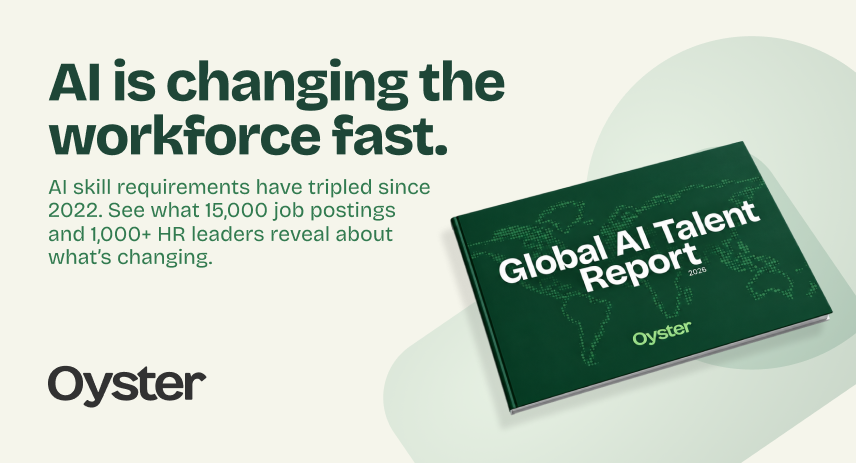


The Global AI Talent Report 2026 draws on approximately 15,000 job descriptions and insights from more than 1,000 HR and People leaders to reveal how AI is changing jobs, talent strategy, and the global search for skills.
AI is changing what companies need from their people. But how quickly is that change actually showing up in the workforce?
Oyster's new Global AI Talent Report 2026 looks beyond predictions about the future of AI to examine what's happening in jobs right now.
We analyzed approximately 15,000 job descriptions posted through Oyster's global employment platform between 2022 and the first half of 2026. We paired that proprietary data with a survey of more than 1,000 HR and People leaders across the United States, United Kingdom, Canada, and Europe, along with interviews with experts working at the intersection of AI, talent, and global employment.
Together, the data reveals a significant shift already underway: AI skill requirements have tripled since 2022.
But that's only the beginning of the story.
AI isn't just creating new jobs. It's changing existing ones.
In 2022, approximately 5% of jobs posted through Oyster explicitly required AI skills. In the first half of 2026, that figure reached 15%.
And the rise has accelerated. The share was still just 6% in 2024 before climbing to 10% in 2025 and 15% in 2026 YTD.
What's especially significant is where those requirements are appearing.
AI fluency is no longer confined to engineering or specialized AI positions. It's becoming part of the skill set companies expect across functions—including marketing, recruiting, operations, and other roles that haven't traditionally been considered technical.
As Jess Von Bank puts it in the report:
“When we say ‘AI talent,’ sometimes people only mean technical talent, which I think is a mistake. Almost every function of a business is becoming AI native or AI fluent.”
That raises a much bigger workforce question: Can the way companies define, develop, and hire talent change as quickly as the skills they expect from it?
The data reveals a gap between expectations and workforce practices
The report suggests that the answer, at least so far, is complicated.
Companies are adding AI capabilities to existing roles, but those new expectations aren't always accompanied by changes in how jobs are defined, communicated, or compensated.
At the same time, employers are making choices about how to close emerging AI skill gaps. Some are investing in the people they already have. Others are hiring externally. Many are doing both.
Those choices matter because they don't just determine who companies hire. They're beginning to change where companies look.
Our research found a notable difference between companies prioritizing internal development and those looking outside their organizations for AI capabilities. Companies prioritizing external AI hiring are nearly twice as likely to have recruited internationally because they couldn't find AI-ready candidates domestically.
For companies competing for AI-fluent talent, the traditional talent map may no longer be enough.
The AI talent search is becoming a global workforce story
Oyster's platform data shows AI requirements appearing in job postings across international markets—not just the places companies might traditionally associate with technology and AI talent.
That creates opportunity. But widening the talent pool also introduces a new set of decisions.
Where are the skills companies need emerging? When should organizations develop talent internally versus recruit externally? How are companies employing AI talent across borders? And what workforce infrastructure do they need when their search becomes global?
These are no longer theoretical questions about what AI might do to work.
They're questions companies are navigating now.
As Oyster CEO Hadi Moussa says in the report:
“Companies can’t keep looking for the same skills in the same places and expect to stay ahead. The opportunity is to build AI fluency across your workforce—and open the door to talent you might never have considered before.”
See what the data reveals
The Global AI Talent Report 2026 explores how quickly AI requirements are entering jobs, where workforce practices aren't keeping pace, how companies are developing and recruiting AI talent, and what happens when that search crosses borders.
Inside the report, you'll find:
- Proprietary analysis of approximately 15,000 jobs descriptions for roles filled through its platform between 2022 and the first half of 2026
- Insights from more than 1,000 HR and People leaders
- Data on how AI requirements are changing across roles and markets
- New findings on how companies are developing, hiring, and employing AI talent
- Perspectives from experts working across AI, talent, and global employment
The workforce is already changing. The new data shows where—and what companies are doing about it.
.webp)