


The EOR vs. entity debate often starts in the wrong place. Many companies think they have to choose one or the other: but that kind of thinking can lead them down the wrong path.
Oyster’s General Counsel Miranda Zolot and Vistra’s Global Head of People Advisory Saul Howerton recently sat down to unpack how leadership teams actually design global workforce structures, combining EOR and entities to move faster, manage risk, and scale sustainably.
Here are five takeaways for HR leaders, finance leaders, and founders building international hiring strategies.
1. Hybrid is the strategy, not a compromise
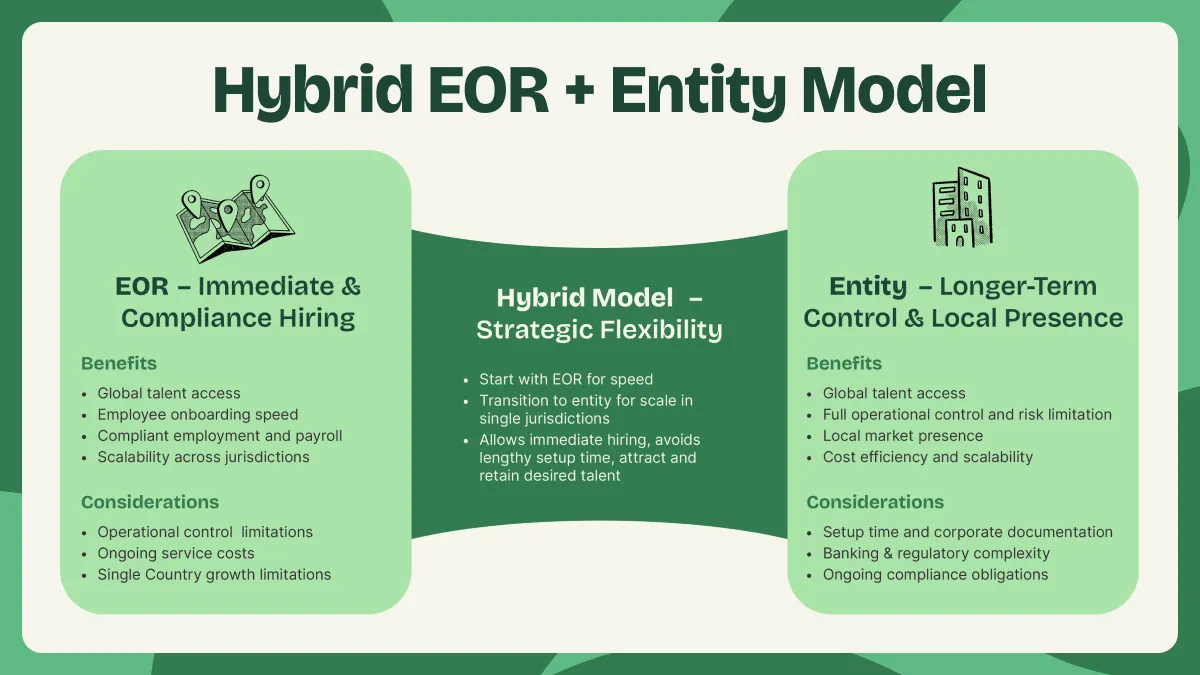
You don’t have to pick just one. A mix of EOR and entities is often the smarter approach, with each model used in different markets at the same time.
To start, let's just establish the definitions of what each of these are:
An Employer of Record (EOR) is a third-party organization that legally employs workers on your behalf, handling compliance, payroll, taxes, and benefits so you can hire in a country without setting up a local presence and manage distributed teams. An entity is a legal business structure you establish directly in a country, giving you full control over operations, hiring, and employment but requiring ongoing legal, tax, and administrative obligations.
An EOR gives you speed and simplicity. An entity gives you more control once your presence in a country grows. But EOR isn’t just a short-term fit. It can be a long-term solution in markets where your footprint is intentionally small.
Some companies stay on EOR in certain countries indefinitely, and in many cases, that’s exactly the right decision.
The real question isn’t “EOR or entity?” It’s: What does this country, at this stage of growth, actually require? Your industry, risk profile, and expansion plans should drive the decision - not a default preference for one model over the other.
2. Setting up an entity is easy. Running it is not.
Creating the entity is often the simplest step. What comes next is where teams get stretched.
Opening a bank account may require an in-person visit, a local director, or regulatory approvals in a language you don’t speak. Then come payroll registration, accounting, tax compliance, and statutory audits. In some countries, like India - you may even need a local server for accounting.
These aren’t one time tasks. They’re ongoing obligations: quarterly filings, year-end payroll compliance, and country-specific reporting requirements. In the Netherlands, for example, companies must track the carbon footprint of employee commutes.
And if your strategy changes, closing an entity is expensive and time consuming costs that are rarely included in the original plan.
An entity also requires a certain level of infrastructure: legal, HR, tax, and payroll expertise. If that support comes from your existing team, you’re not just adding cost: you’re pulling focus away from your core business. A partner in this can make a huge difference.
3. When EOR stops being enough: 4 signals to watch
Every company is different, but a few common inflection points tend to trigger the move toward an entity:
- Headcount growth
There’s no fixed number, but at some point, whether it’s five employees or ten - you’ll start questioning whether EOR still makes sense. When you’re asking the question, you’re likely close to the tipping point. - Revenue activity
If you’re generating meaningful revenue or building strong customer relationships in a country, you may create permanent establishment risk. That can trigger local tax obligations, and EOR doesn’t eliminate that exposure. - Investor expectations
Some investors are unfamiliar with or cautious about the EOR model. During fundraising or M&A, they may push for direct ownership of workforce structures, accelerating the move to an entity. - Senior hires
Hiring senior leadership in a market often signals long term commitment. At that point, an EOR setup may no longer reflect the level of presence your business is building.
4. Know your exit before you make your first hire
Expansion plans are built around hiring, but they’re tested when people leave.
Termination rules vary widely. In France, for example, ending employment requires a formal process that includes registered mail sent through the French postal system and legally mandated consultation periods. For companies used to at-will employment, this can be a major shift.
In some cases, exit costs can be significant. A non-performing employee may still be entitled to months of pay due to local labor laws.
There’s also an important limitation with EOR: redundancy is not always a valid reason for termination. Because the EOR employs workers across multiple companies, eliminating a role within your business doesn’t necessarily qualify as redundancy under local law.
Before entering a market, understand the full exit picture: costs, timelines, and legal constraints. It’s far easier to plan upfront than to navigate these challenges mid-process. Cost calculators can be useful.
5. Plan the EOR to entity transition before you need it
Moving employees from EOR to an entity is manageable - if you plan ahead. If not, it can quickly become a trust issue.
Benefits are often the biggest challenge. EOR providers typically offer pooled benefits, which can be more comprehensive. When you switch to an entity, that pooling disappears, and matching those benefits for a smaller team can be difficult.
Some companies use allowances to bridge the gap, but the key is to anticipate this before making any announcements. Employees will notice the difference.
Even smooth transitions come with legal requirements. Many countries require formal consultation and notification. Clear, early communication is critical, otherwise, uncertainty can erode trust.
Watch the full on-demand webinar to hear Miranda and Saul work through real-world scenarios. View more Oyster and Vistra content here, or book a call there to speak about the hybrid model.

.avif)