

For decades, HR technology did one thing really well: store information. Employee profiles, policy documents, compliance records - all neatly filed away in digital cabinets. But storing data and acting on it are two very different things. Today, the most forward thinking people teams are making a fundamental shift: from systems of record to systems of action, and AI is making it possible.
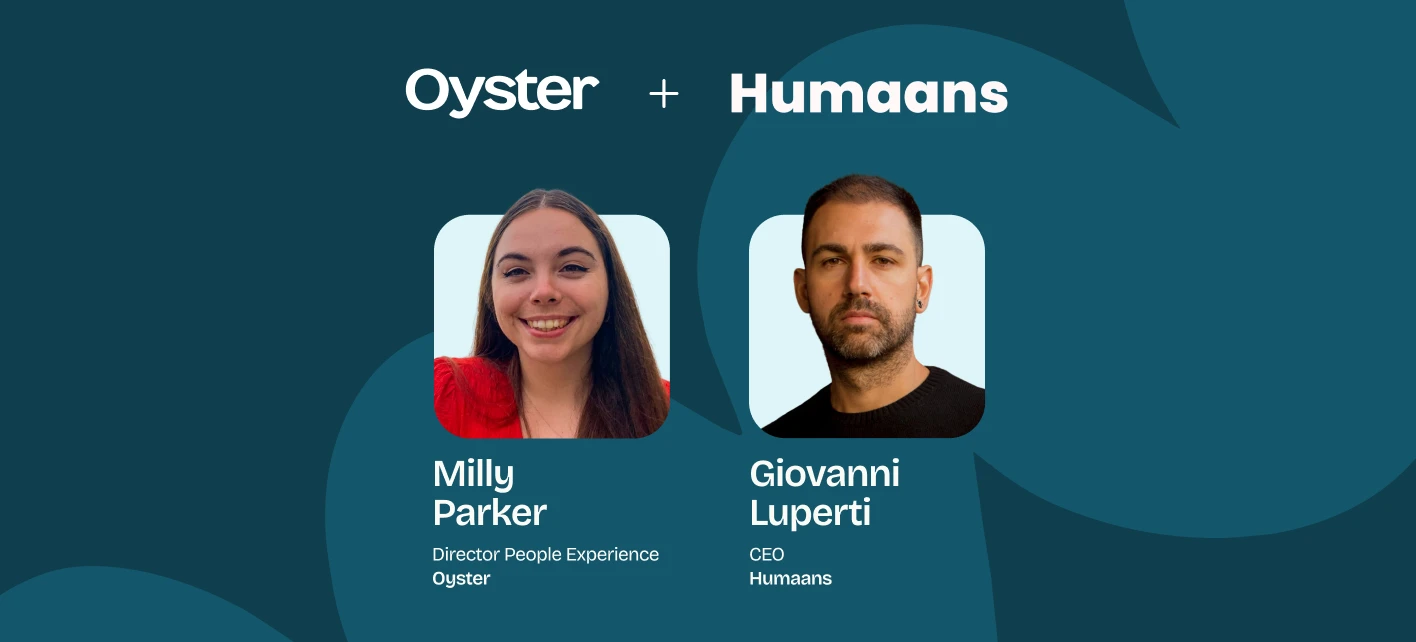
We recently sat down with Milly Parker, Director of People Experience at Oyster, and Giovanni Luperti, CEO and co-founder of Humaans and Athena, to talk through what this shift looks like in practice: and what it means for teams trying to grow globally without losing the human element that makes great people ops possible.
Your HR System Should Do More Than Store
Most HR tech stacks were built on the same underlying logic as the filing cabinets they replaced: capture, store, retrieve. The interfaces got better. The databases got bigger. But the core model stayed the same: static employee profiles, rigid workflows, systems that documented the past rather than shaped the future.
That worked fine when businesses changed slowly. It starts to break down when you're reorganizing every six months, expanding into new markets, or managing a workforce spread across 70 countries with different compliance requirements, time zones, and employment norms. Static systems don't scale with complexity. They create it.
The real shift isn't about adopting AI for its own sake. It's about building a people stack that can actually keep pace with how fast businesses move today.
What "Systems of Action" Actually Look Like
The phrase "AI-powered HR" gets thrown around a lot. But what does it mean on a Tuesday morning when your team is buried in employee queries from fifteen different countries?
At Oyster, one of the first wins was intelligent prioritization. With employees spread across 70+ countries, the people team was spending significant time digging through knowledge bases and consulting local partners just to figure out which issues needed attention first. AI now helps to surface what's genuinely urgent versus what can wait, without the team having to do that digging themselves. Less time on triage. More time on the people behind the tickets.
On the business side, the impact can show up differently: in attrition risk analysis that flags problems before they become departures, in automated leadership reporting that doesn't require someone to chase down data every month, in reduced manual errors across payroll and compliance workflows.
A Real Before-and-After: Performance Reviews
During Oyster's recent performance review cycle, managers were spending hours hunting down scattered notes, trying to reconstruct months of feedback before sitting down to write. The process was slow, inconsistent, and frankly - exhausting.
However, with AI tooling built in, managers can now pull their notes together and receive a working draft. They are becoming editors, not drafters. The reviews move faster, and leave more time for the actual conversation.
Oyster has expanded this further: employees now have AI updated performance profiles, and managers can use AI coaching tools to ask questions like, “Am I giving feedback consistently across my team?” This isn’t automation replacing judgment - it’s helping managers apply it more effectively.
Starting Small (and Starting Smart)
You don't need to overhaul your entire stack to get started.
- Begin with low-risk, high repetition use cases. A benefits FAQ chatbot. Automated summaries of engagement data. Small proof points that build organizational confidence before you scale.
- Think about integration before automation. Connecting your existing systems often unlocks capabilities you didn't know you had, and sometimes reveals that you don't need AI at all, just better data flow.
- Treat AI like an enthusiastic intern. It wants to help, it has great ideas, and it occasionally goes off in a direction you need to course correct. That mindset keeps humans in the loop without dismissing the technology's real value.
The Human Part Still Matters The Most
AI doesn't reduce the need for human judgment in people ops. It creates more room for it.
When AI handles prioritization, drafting, research, and repetitive queries, people teams get back the time to do what no system can - be present with employees, navigate sensitive situations with care, make the calls that require context and empathy that software doesn't have. For global companies managing compliance, culture, and employee experience across dozens of countries, that capacity isn't a nice-to-have. It's the job.
The best thing AI can do for a people team is make it more human. Not less.
Watch the Full Conversation
This blog only scratches the surface of the topic. Milly and Gio went deep on workflow readiness, change management, data governance, and what the AI-enabled people team actually looks like day to day.
Watch the on-demand webinar here.
You'll walk away with a clearer picture of where to start, what to avoid, and how teams are already making this work: without losing the human element that makes great people ops possible.